

Not every client in your book is a fit for a solar PPA and knowing the criteria before you start the conversation saves everyone time. The good news is the qualifying bar is relatively low and, once you know what to look for, spotting a strong candidate becomes second nature.
Fortunately, the UrbanVolt partner portal enables you to qualify a client for a solar PPA in seconds.
For a full overview of how the consultant partnership model works and what makes solar a strong addition to an energy proposition, see How Energy Brokers Add a Solar PPA to Their Proposition.
Consumption: a rough guide, not a hard line
If you ask what the minimum usage threshold is, we would say around 250,000 kWh of daytime electricity a year will almost certainly qualify. It’s a useful number to work from when you’re scanning a client list. But it’s a loose one, and the real picture underneath it is more nuanced than a single figure suggests.
Start with “daytime” itself. There’s no single industry-standard definition of what counts as daytime consumption. Different suppliers set different day/night boundaries – often tied to their own time-of-use or off-peak tariff structures – so the same set of half-hourly data can produce a different daytime figure depending on whose definition is applied and likely won’t align entirely with when a solar array generates electricity. It’s one of the reasons a rough number from a client conversation is a starting point rather than a verdict.
The bigger nuance is how the system gets sized. UrbanVolt designs for optimised self-consumption, rather than hitting a headline kWh figure. That means the design follows the shape of a client’s actual usage pattern, not just the total. A client operating five days a week, for example, will have two days where the site is quiet or closed, and the system still generates on those days regardless. Without anyone on-site consuming it, that generation goes unused or is exported to the grid, which is exactly why raw annual consumption alone doesn’t tell the full story.
It’s also worth knowing what a minimum-sized system produces in practice. UrbanVolt’s minimum size for a single-site system is 50 kWp, which at a UK typical yield (850 kWh/kWp) delivers somewhere around 42,500 kWh a year. That’s a useful reference point for gauging whether a smaller site is genuinely worth pursuing, rather than working purely off the 250,000 kWh headline figure.
None of this needs to be worked out by hand. If a client’s usage pattern looks promising but doesn’t obviously clear the rough threshold, it’s worth running through UrbanVolt’s partner portal or raising directly. The nuance in how systems are sized means some sites that look borderline on paper turn out to be strong candidates once the real usage pattern is considered.
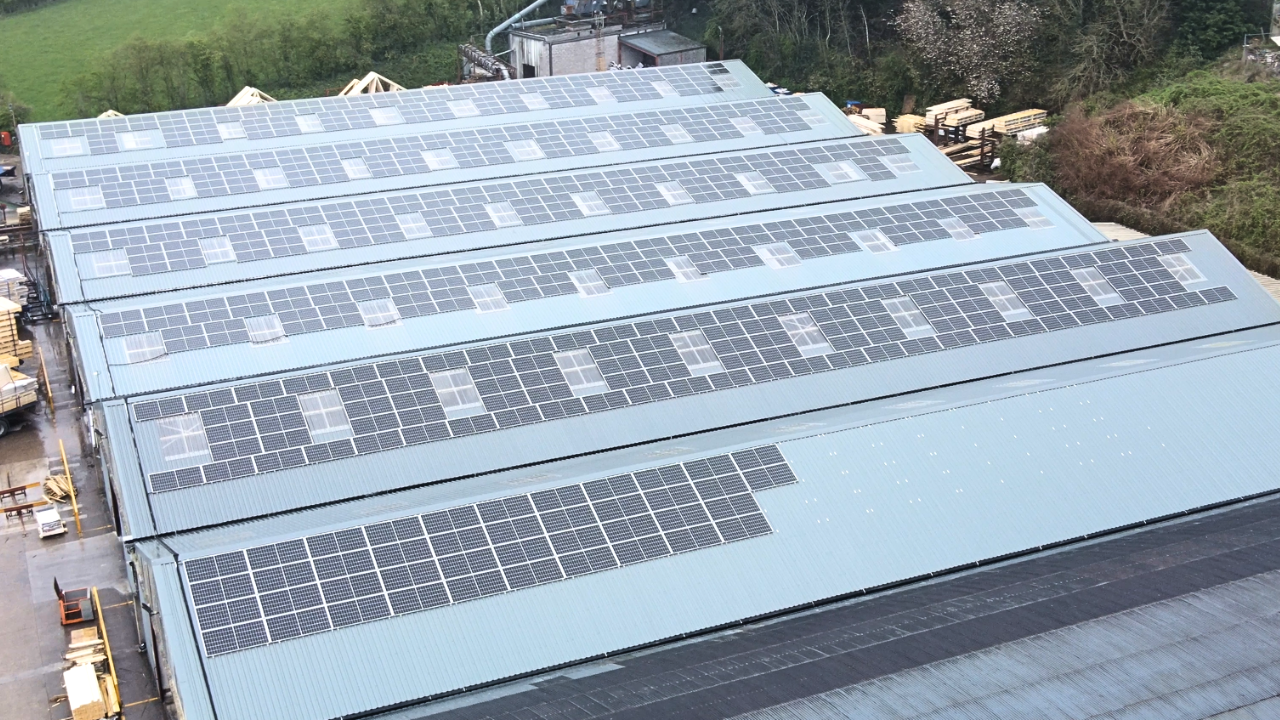
Roof: 500m² of usable space, in reasonable condition, without significant shading
Total roof area and usable roof area are two different numbers, and it’s the second one that is important for a solar installation. Skylights, HVAC units, plant equipment, and existing rooftop structures all eat into what’s available for panels, so a roof that looks generous from the outside can shrink considerably once those are accounted for.
Flat or trapezoidal roofs – the kind found on most warehouses, distribution centres, and manufacturing units – tend to be the easiest fit, since they maximise usable area. Shading is the other factor worth a visual check: overhanging trees, taller adjacent buildings, or nearby structures that cast shadow across a meaningful part of the roof during the day will affect how much of that space is productive.
None of this needs a technical assessment from you. A client who can describe their roof as flat, largely clear, and reasonably sized is very likely to clear this criterion and you can always look on Google Earth. The detailed sizing is then confirmed by UrbanVolt at desktop proposal stage.
Tenure: ownership or a lease of ten years or more
The contract needs enough runway to make sense, which is really what this criterion comes down to. A client who owns their building is in the simplest position. A client with a lease of ten years or more remaining is just as viable.
Shorter leases aren’t an automatic no. Where the lease has less time left, the client can choose to take ownership of the array if they leave the premises, or the conversation can wait until a renewal is already in motion. It’s worth taking the client through the different options – tenure situations vary more than people expect, and there’s often a degree of flexibility.
Credit profile: financially stable enough for a long-term agreement
A PPA is a long-term commitment on the client’s side as well as UrbanVolt’s, and the client needs a financial position stable enough to support that – an Experian score of 75 or above. For many established commercial and industrial businesses, it’s a baseline check rather than a high bar.
Where a newer business might not clear it on its own, it’s worth checking whether a parent company or group entity could contract instead. That resolves the question more often than people assume, and it’s a five-minute conversation rather than a reason to walk away from an otherwise strong site.
Where to look first
Beyond the four criteria, the strongest fits tend to be businesses with a fairly consistent load profile during the day – operations that don’t swing wildly between empty and full capacity. Construction, engineering, food and beverage, heavy manufacturing, logistics, printing, retail, and agriculture are where UrbanVolt sees this play out most often. If your book has clients in any of these sectors, there’s a good chance your clients are suitable for a solar PPA.
The fastest way to check
You don’t need to work through this list manually for every client. UrbanVolt’s partner portal takes a handful of site details and returns an indicative PPA estimate in seconds. Run a client through it and you’ll know within moments whether it’s worth taking further.
That’s really the whole exercise. You’re not assessing feasibility from scratch – you’re checking a short list of criteria against clients you already know well, using a tool that does the maths for you. For a lot of consultants, the surprise isn’t how narrow the qualifying pool is. It’s how many clients already fit it.
Interested in partnering with UrbanVolt? Take a look at our partner page, or contact us to talk through the process.